
By Nayebare Dominic,
Founder/Chief Technical Officer – Granville Tech
A student in sub-Saharan Africa uses a computer during class. Emerging AI technologies – predictive analytics, generative models, and autonomous “agentic” systems – are poised to transform such learning experiences across the continent.
Introduction
Africa faces a profound education crisis, with surging student populations, chronic teacher shortages, and inadequate infrastructure. As of 2024, UNESCO estimated that 58% of adolescents (15–17 years) in sub-Saharan Africa are not attending school, and about 98 million children are out of the education system entirely. The urgency to improve access and quality is clear. In this context, artificial intelligence (AI) offers new tools to amplify human potential rather than replace it. Different forms of AI – predictive, generative, and agentic – each bring distinct capabilities that can address Africa’s educational challenges. In the sections below, we describe these AI types and explore their relevance to education, highlight current African initiatives using them, and analyze their potential impact on critical areas like access, affordability, personalization, teacher support, language inclusivity, and curriculum development.
AI Technologies and Their Educational Relevance
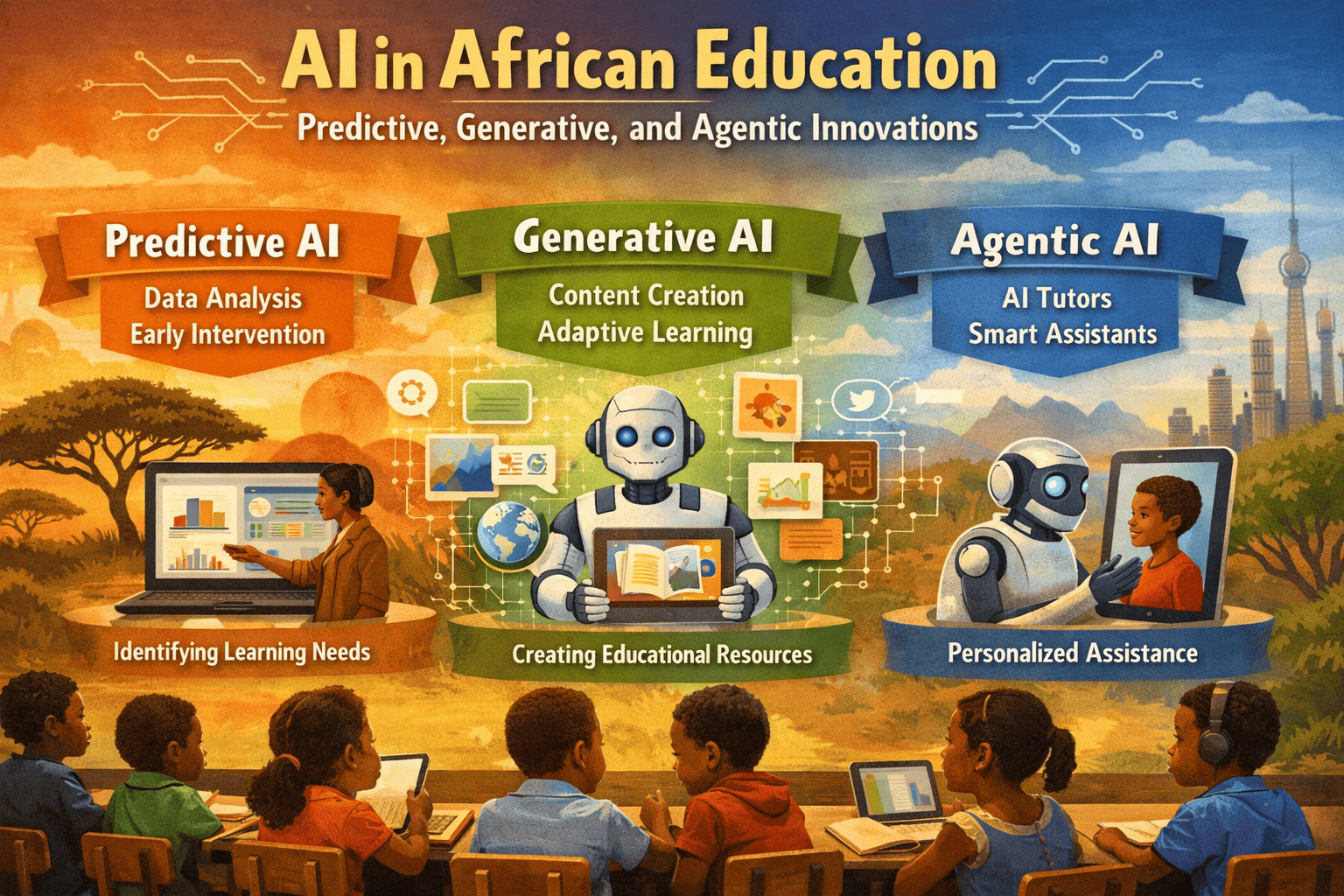
Predictive AI in Education
Predictive AI refers to systems that use data to forecast outcomes and inform decision making. These AI models identify patterns in historical data to predict future events or needs. In education, predictive analytics can power early warning systems and data-driven planning. For example, machine-learning models can predict which students are at risk of dropping out or failing by analyzing attendance, grades, and other factors, enabling timely interventions by teachers. At a policy level, predictive AI helps Ministries of Education make informed decisions: it provides real-time data on school performance and enrollment, allowing leaders to spot underserved regions, forecast teacher demand, and allocate resources proactively
rather than reactively. By anticipating needs – from identifying students who need extra support to projecting where new schools or teachers will be required – predictive AI can improve education access and efficiency. It essentially functions as a digital assistant for planning, ensuring that scarce educational resources in Africa are directed where they matter most.
Generative AI in Education
Generative AI includes models like ChatGPT and others that can produce new content (text, code, images, etc.) in response to prompts. These AI systems have a creative capacity, making them valuable for generating educational materials and interactive learning experiences. In African education, generative AI is already being used to create content in local languages and to support both students and teachers. For instance, large language model chatbots can generate explanations, example problems, or quizzes tailored to a student’s needs, functioning as on-demand tutors. Generative AI is also helping overcome content shortages by auto-creating learning materials: a nonprofit in Mali used a combination of ChatGPT (a generative AI), machine translation, and human editing to produce over 180 culturally relevant children’s books in the Bambara language in under a year. This project, RobotsMali, achieved these books at a fraction of the usual cost, addressing the dearth of reading resources in an African language and illustrating how generative AI can expand curriculum content affordably.
Likewise, generative AI can assist teachers by drafting lesson plans, creating worksheets, or
even translating content into students’ mother tongues. In short, generative AI’s relevance to
education lies in its ability to personalize learning content and automate the creation of
materials, which is especially powerful in Africa where quality textbooks and teaching
resources in local languages are often scarce.
Agentic AI in Education
Agentic AI refers to emerging AI systems with a level of autonomy and ability to take actions – essentially AI “agents” that can plan, learn, and act independently to achieve goals. These partially autonomous agents handle tasks like scheduling, tutoring interactions, or administrative workflows with minimal human input. In education, agentic AI might take the form of an intelligent tutoring system that not only delivers content but also dynamically adjusts its strategy, or a virtual assistant that automates school management tasks. For example, an agentic AI could autonomously coordinate individualized lesson sequences for a student: assessing their progress and deciding to review foundational concepts or introduce advanced challenges without a teacher’s prompt. In African schools, where one teacher may
manage large, multilevel classrooms, such AI agents can help bridge the guidance gap. Early instances are appearing – in Kenya, teachers are piloting a chatbot assistant called “Kalasik” that automatically generates lesson plans and handles repetitive tasks, serving as a virtual teaching aide. This kind of agentic system acts like an “extra pair of hands,” taking over routine work (grading, scheduling, answering frequently asked questions) so that human educators can focus on mentoring and one-on-one support.
As agentic AI matures, it holds promise for partially autonomous tutoring as well: imagine a student engaging with an AI tutor that can not only answer questions but also proactively guide the student through a curriculum, much like a human tutor, including deciding when to review, give hints, or assess understanding. Such agents could be deployed over simple interfaces (even via SMS or WhatsApp), making them accessible in low-resource settings. Agentic AI thus introduces a new dimension of automation in education – one that, if carefully managed, could significantly augment teaching capacity and personalize learning at scale.
Current AI Applications in African Education
Across Africa, a variety of innovative projects – from grassroots initiatives to government pilots – are already deploying predictive, generative, and agentic AI in education. Below are several notable examples, illustrating how these AI technologies are being used on the ground:
Data-Driven Education Planning – Ministries in countries like Kenya, Zambia, and Côte d’Ivoire are using AI-based predictive analytics to inform policy. These tools analyze demographic and school data to forecast needs (e.g. where new teachers or schools will be required) and identify low-enrollment areas, shifting planning from crisis response to proactive delivery. By integrating AI into education strategy,
governments aim to target resources more effectively and improve access in underserved communities. In fact, Kenya’s national AI strategy (2025–2030), developed with UNESCO, places a strong emphasis on digital skills in schools and data use in education management.
AI Lesson Planning Assistants – In Kenya, teachers are piloting the Kalasik assistant, a chatbot that uses generative AI to create lesson plans aligned with the curriculum and to automate routine paperwork. Similarly, in Ghana, an edu-tech startup founded by a former teacher is developing an app that allows teachers to input details about their students’ varying ages and learning styles – the AI then generates customized lesson plans based on the national curriculum. These tools save teachers countless hours in preparation, ensuring even under-resourced rural teachers can access quality lesson frameworks and adjust them for their classes. By lightening teachers’ workloads, such AI assistants directly tackle the teacher shortage problem.
Personalized Tutoring Chatbots – Several projects offer students AI-powered tutoring and homework help. In West Africa, the “Kwame for Science” digital tutor has been deployed across 11 countries to help secondary students with science questions, boasting an 87% accuracy rate in its top answers. In Nigeria, the popular e-learning platform ULesson introduced an AI chat tutor to answer students’ queries on-demand (leveraging GPT-style models), and another Nigerian-built tutor bot called Henotace is tailored for local curricula. Likewise, Rori is a virtual math tutor being rolled out by Rising Academies in Ghana and Sierra Leone – accessible via a simple chat interface, Rori provides step-by-step math guidance and practice. It has been tested in over 50 schools and is designed to be inclusive and accessible via mobile; the project’s ambition is to more than double math learning outcomes for students across Africa using this AI tutor. These generative/agentic tutor systems allow learners to get instant help and practice outside of class, something especially valuable where teacher time is limited.
Inclusive Learning Tools (Assistive AI) – AI is also being harnessed to support learners with disabilities and those facing language barriers. At Maseno University in Kenya, researchers developed an AI tool that translates between English and Kenyan Sign Language in real time, to help Deaf students communicate with hearing peers and teachers. This AI-powered sign language translator, supported by the Artificial Intelligence for Development (AI4D) program, was created in collaboration with Deaf communities and exemplifies how AI can foster inclusion. Other projects are leveraging speech and translation technologies to make educational content more accessible: for instance, local African organizations (backed by IDRC and GPE) have built text-to-speech and machine translation tools that convert learning materials from English/French into local languages, or read them aloud – benefiting students who are visually impaired or who struggle with foreign languages of instruction. These grassroots innovations enable more children to learn in the language they understand best.
Local Language Content Creation – Overcoming the chronic shortage of learning materials in African languages, projects like RobotsMali are using generative AI to create books and curricular content rapidly. RobotsMali, a nonprofit in Mali, combined ChatGPT with human editors to produce 180 children’s storybooks in Bambara (a Malian language) within a year. The availability of these books – produced at a fraction of the usual cost – is a breakthrough in a country where many speak Bambara but few can read it due to lack of written material. By dramatically lowering the cost and time required to develop educational content, AI is helping preserve African languages and improve literacy. Likewise, an initiative in Benin, Cameroon, and the DR Congo (the STEPS project) used AI tools alongside open educational resources to develop highquality, locally relevant science textbooks for primary schools. The AI assisted in drafting content based on each country’s curriculum, suggested culturally appropriate examples, and helped translate and localize the textbooks. This blend of human curriculum experts with generative AI accelerates curriculum development while ensuring materials fit the local context.
AI for School Administration – AI is also being trialed to ease school management and support education leadership. In one pilot from an NGO accelerator, a “school leader’s companion” app is under development by a former teacher in Kenya. This agentic AI app will help principals with tasks ranging from teacher recruitment and timetabling to student behavior management and even marketing of the school. The idea is to provide a “partner in the pocket” for headteachers, giving real-time suggestions and decision support. Such an app could be invaluable for heads of small community schools who often have minimal administrative staff. Early-stage projects like this underscore the appetite for AI not just in classroom instruction but in the behind-the-scenes running of educational institutions.
Each of these examples demonstrates a facet of how AI is being localized for African education needs. Many are grassroots-driven innovations, spearheaded by local educators, startups, or research groups often with support from international partners (e.g. UNESCO, IDRC, GPE, Opportunity International). At the same time, several African governments are moving beyond pilots to integrate AI into their national education strategies, as we will discuss in later sections.
Potential and Emerging Impacts of AI on Key Educational Goals
Expanding Access to Education
One of the most transformative impacts of AI in Africa could be broadening access to education. With millions of children out of school and not enough teachers or schools for all, AI tools offer new pathways for learning outside the traditional classroom. Generative and agentic AI systems enable remote, self-paced learning, which is critical for students in conflict areas, nomadic communities, or those with disabilities who cannot attend school regularly. For example, AI tutoring chatbots (accessible via common platforms like WhatsApp) allow students in rural or underserved areas to learn and ask questions with only a basic smartphone and intermittent connectivity. Projects like Rori and Kwame for Science give students academic support after school hours, potentially reaching those who have no access to private tutors or well-resourced schools. Studies have shown that such AI tutors can keep learners engaged and even reduce dropout rates by providing individualized attention that crowded classrooms cannot.
AI is also tackling language and literacy barriers that impede access. Rather than requiring young learners to master English or French first, AI translation and content generation tools can deliver lessons in students’ mother tongues, making education more inclusive. UNESCO notes that AI can “improve access to learning in students’ mother tongues”, citing it as a key application of AI in education. We see this in practice with the creation of Bambara-language books in Mali and similar efforts for other local languages. By lowering the language barrier, AI opens the door for millions of African children to start learning core subjects in their home language, which research shows leads to better understanding and retention. Additionally, AI-powered platforms can adapt content for learners with special needs – such as providing
sign language interpretations for Deaf students or audio narration for those with visual impairments – thereby extending educational access to students often left behind.
On a systemic level, predictive AI analytics contribute to access by helping governments identify where educational access gaps are widest. AI can analyze population and school data to find “cold spots” (e.g. remote regions with many out-of-school youth) so that initiatives (building schools, deploying online programs) can be targeted there. For instance, if data shows a particular district has very low secondary school enrollment, authorities can respond with mobile learning centers or radio/AI educational broadcasts for that region. In summary, AI tools – both those in students’ hands and those guiding policymakers – are emerging as a means to democratize access to learning opportunities across Africa’s diverse and challenging contexts.
Improving Affordability and Efficiency
Affordability is a crucial factor in African education, both for families and governments. AI has the potential to lower costs and increase the cost-effectiveness of education delivery in several ways. One clear example is in content production: generative AI dramatically reduces the time and expense needed to create textbooks, lesson plans, and educational media. The RobotsMali project producing books in Bambara demonstrated cost savings on content creation, delivering hundreds of books at a fraction of the usual cost by leveraging AI assistance. Likewise, the STEPS project in Benin/Cameroon/DRC used AI to draft and localize textbooks more efficiently than traditional manual authoring. By cutting publishing and development costs, AI-generated open educational resources can make learning materials more affordable or free for students – easing the burden on families who might otherwise have to buy textbooks.
For education systems, AI automation brings efficiency gains that can indirectly save money. Tasks like grading exams, scheduling classes, or processing student admissions – which would normally consume many staff hours – can be partially or fully automated by AI, reducing administrative overhead. Some African schools are experimenting with AI grading systems for essays and homework, allowing teachers to focus on instruction rather than paperwork. Similarly, the school leader management app from Kenya is intended to streamline operations in low-cost private schools, potentially improving how these schools are run without requiring expensive consultancy or additional admin staff.
Another area is optimization of resource allocation: predictive models can help ensure that limited funds are spent where they have the highest impact. By forecasting needs (such as where student enrollment is growing fastest), AI can inform smarter investments (e.g. building a new school exactly where it’s most needed, or training the right number of teachers for a subject shortage). This data-driven approach minimizes waste and maximizes the value obtained from education budgets, improving affordability at the macro level.
There is also hope that AI tutors and learning apps can deliver personalized tutoring at scale for a relatively low marginal cost. Traditional one-on-one tutoring is effective but expensive; AI tutors, once developed, can serve countless students with minimal additional cost per student, essentially offering “large-class tutoring for the cost of one”. Early research even suggests well-designed AI tutoring systems can rival or exceed typical classroom learning gains. If those findings hold in African contexts, it means countries might boost learning outcomes without proportionally boosting spending, thus increasing the cost-efficiency of education – a vital consideration for under-resourced school systems.
Of course, realizing these affordability gains depends on initial investments and overcoming infrastructural challenges (electricity, devices, connectivity). But in the long run, AI could help bend the cost curve of providing quality education, making it more financially sustainable to educate Africa’s booming young population.
Personalization of Learning
Perhaps the most celebrated benefit of AI in education is its ability to personalize learning – tailoring instruction to each student’s level and needs. In Africa’s typical classrooms, a single teacher may handle 40, 60, or even more than 100 students, making individualized attention virtually impossible. AI tutors and adaptive learning systems can fill this gap by acting as personalized coaches for students. They can adjust the difficulty of exercises in real-time, give immediate feedback, and present topics in different ways until the student grasps the concept. This kind of customization keeps learners engaged and progressing at their own pace. As one report noted, “AI adapts learning to each student’s needs… Personalized learning keeps students engaged and cuts dropout rates, especially in rural and marginalized communities.” Students no longer feel lost in a one-size-fits-all lecture – the AI can stretch advanced learners and gently reinforce basics for those who are struggling.
We are already seeing this in action: the Rori math tutor, for example, will repeatedly prompt a student to try a solution and offer hints, only revealing the answer after the student has made several attempts. It then gives a new question to ensure practice continues. This adaptive loop is something even a diligent teacher would struggle to do for every student, but an AI can manage it tirelessly. Similarly, generative AI-based tutors like ChatGPT (when guided properly) can rephrase explanations in simpler terms if a student is confused, or provide more examples on the fly. In West Africa, the Kwame for Science chatbot not only answers science questions but can do so in French or English and at various difficulty levels, accommodating students across 11 countries with different curricula. Such multilingual and curriculum-aware personalization is particularly relevant in Africa’s diverse educational landscape.
Personalization through AI also extends to learning styles and interests. If a student learns better with stories or real-life applications, a generative AI can frame problems in familiar contexts – for instance, incorporating local culture or everyday scenarios into a math word problem. The STEPS textbook project used AI to suggest “culturally relevant examples and contexts” for science lessons in each country, enhancing relevance and student interest. Over time, AI systems could even detect a learner’s preferred style (visual, textual, interactive) and adapt content delivery accordingly.
The emerging impact of this personalization is profound: students who might have been left behind in a large class can finally learn at a comfortable pace, receive instant clarification on doubts, and stay motivated through interactive, game-like feedback. This leads to better learning outcomes and more confident learners. It’s important to note, however, that to fully realize AI-driven personalization, students need access to devices and a basic level of digital literacy – issues that initiatives and policies must address concurrently. Nonetheless, personalization is one of AI’s strongest contributions to making African education not just more inclusive, but also more learner-centered and effective.
Teacher Support and Training
Far from rendering teachers obsolete, AI in Africa is showing great promise as a lifeline for overworked educators and a tool for teacher professional development. The continent needs an estimated 16.5 million additional teachers by 2030 to meet the demand, a gap that cannot be closed quickly by traditional means alone. AI can help by augmenting teacher capacity in several ways:
- Automating Routine Tasks: Grading assignments, taking attendance, preparing quizzes, and compiling reports are all time-consuming tasks that AI systems can handle or assist with. By automating these administrative burdens, AI frees up teachers’ time to focus on actual teaching and mentoring. For instance, the Kalasik chatbot in Kenya demonstrates how an AI can generate lesson plans and handle repetitive paperwork, saving teachers hours each week. Likewise, AI-driven grading tools can instantly mark multiple-choice tests or even provide initial scoring for essays, which teachers can then review for accuracy.
- Instructional Resources and Planning: AI serves as a creative partner for teachers, helping them develop better lessons. Generative AI can supply teachers with drafts of syllabi, ideas for classroom activities, or even tailored explanations for difficult concepts. The Ghanaian teacher’s lesson-planning app described earlier is a prime example – it takes into account the unique mix of student abilities in a class and produces a lesson plan aligned to the curriculum. This not only eases the lesson planning load but also builds teacher confidence in handling diverse classrooms. In resource-constrained schools, where teachers may lack access to up-to-date training or materials, having an AI assistant is like having a veteran mentor teacher on call to suggest best practices and provide content.
- Professional Development and Coaching: AI can also play a role in training and upskilling teachers themselves. Virtual “coach bots” or intelligent tutors for teachers can provide on-demand guidance in pedagogy, subject content, or classroom management techniques. For example, an AI-powered virtual coach might observe (through video or data) a teacher’s lesson and give feedback on how to improve student engagement or inclusivity. In simulation-based training, AI can create virtual classrooms with simulated students, allowing new teachers in Africa to practice classroom management or try new teaching strategies in a safe environment before applying them in real life. Such AI-driven teacher training tools are still emerging, but they hold potential to scale quality training to thousands of teachers simultaneously –something urgently needed in countries where remote or rural teachers rarely get inperson training workshops. Indeed, UNESCO’s Africa-focused initiatives have highlighted AI’s role in empowering teachers and enhancing teaching, whether through tailored training or AI-created content that teachers can use in class.
- Real-Time Classroom Support: In the future, we may see AI systems acting as realtime teaching assistants during lessons. For instance, an AI agent might monitor a class (via cameras or student devices) and alert the teacher if many students seem confused, or even directly assist students who get stuck, all in real time. Some experimental systems globally have used AI to track student comprehension signals and prompt teachers to intervene where needed. While such advanced setups are not common yet in Africa, simpler versions exist – like a teacher having a chatbot on their phone to quickly look up alternative explanations or translations during a lesson.
The impact on teachers from these AI supports is multifaceted. First, it can greatly reduce burnout and improve job satisfaction by removing drudgery and providing creative support. Teachers can devote more energy to interactive teaching and mentoring – the human elements of education that AI cannot replace. As one UNICEF review of EdTech noted, successful digital learning still “depends not just on good software, but on teachers” who provide critical human support and scaffolding. By alleviating pressure on teachers, AI helps them do this human-centered work better. Second, AI can make teachers more effective by continuously upgrading their skills and knowledge. This is especially valuable in fast-changing fields (like adapting to new curricula or including 21st-century skills). If scaled, AI-driven teacher training could ensure that even teachers in remote villages are up to date on modern pedagogical techniques and subject matter, ultimately improving student learning outcomes. Finally, by incorporating AI in their workflow, teachers also become facilitators of a blended learning environment, guiding students in using AI tools wisely – a new dimension of the teacher’s role in the 21st century. The net effect is a vision of teachers and AI working in tandem, each enhancing the other’s strengths for the benefit of students.
Overcoming Language Barriers
Africa’s linguistic diversity is a well-known challenge in education. Many students must learn in a colonial language (English, French, Portuguese, etc.) that is not spoken at home, leading to comprehension difficulties, especially in early grades. AI technologies are emerging as powerful tools to bridge language gaps and enable multilingual learning environments. Key impacts in this area include:
- Translation and Multilingual Tutoring: Modern AI translation models, trained on vast multilingual datasets, can translate educational content at a scale and speed previously impossible. This means textbooks, storybooks, and lesson materials can be rapidly translated from major languages into local African languages. For example, AI projects in East and West Africa are translating digital educational resources into languages like Swahili, Hausa, Yoruba, and others, often using neural machine translation combined with human oversight for quality. Similarly, generative AI chatbots can be fine-tuned to understand questions in a local language and respond in that language, effectively acting as bi-lingual tutors. The agriculture chatbot Ulangizi in Malawi (though focused on farming advice) demonstrates this by answering farmers’ queries in Chichewa fluently – a concept that can extend to answering students’ questions in their mother tongue for academic subjects. This capability helps inclusivity: students no longer have to wait until they’ve mastered English or French to start learning science or math; they can build knowledge in their own language, making education more equitable for rural and first-generation learners.
- Content Creation in Local Languages: As highlighted earlier, generative AI is enabling the creation of original content (stories, exercises, explanations) directly in under resourced languages. This is crucial because even translation has limits if there are no base materials to translate. RobotsMali’s Bambara books show how AI can kickstart content ecosystems for languages that have been historically neglected in print. African educators and authors are beginning to use tools like GPT-4 with prompts in their language to generate poems, reading passages, or examples that resonate culturally and linguistically with their students. Over time, we can expect a blossoming of learning materials in dozens of African languages, greatly enriching the curriculum and literacy opportunities. Language preservation is an added benefit – AI can help document and disseminate languages (through speech recognition, text generation, etc.), supporting cultural heritage while educating.
- Real-Time Interpretation: AI-driven speech recognition and synthesis can facilitate real-time language support in classrooms that have mixed language groups or for students who are learning a new language. For instance, an AI app on a tablet could listen to a teacher’s lesson in English and simultaneously display key phrases in a local language for students who need it, or vice versa, thus acting as a live interpreter. The Kenyan Sign Language translator tool is analogous – it listens to spoken English and generates sign language, and can also translate sign back to text, thereby enabling Deaf students to follow mainstream class instruction. In multilingual African societies, one could imagine AI earpiece translators for education contexts, though that is still experimental.
- Language Learning: On the flip side, AI also helps students learn new languages more effectively. Personalized language learning apps with AI tutors can provide pronunciation feedback, conversational practice, and grammar correction in indigenous languages and international languages alike. This is significant in Africa where being multilingual is an asset – AI can help kids become fluent in the official language without losing their mother tongue, by supporting both in tandem.
The overall impact of these developments is a reduction in language as a barrier to quality education. More children can learn in their first language, which research indicates leads to stronger foundational skills. They can also transition to global languages more smoothly with AI-based support. Culturally relevant multilingual education becomes easier to implement when AI handles the heavy lifting of translation and localization. By embracing these technologies, African education systems can move toward the ideal of mother-tongue based multilingual education, ensuring no child is left behind due to the language they speak at home.
Curriculum and Content Development
AI is also influencing what is taught and how it’s developed – essentially, curriculum design and content creation. Traditionally, developing curricula or textbooks is a slow, expert-driven process that might be updated only once a decade in many African countries. AI offers tools to make curriculum development more responsive, data-informed, and localized:
- Data-Informed Curriculum Updates: Predictive analytics can reveal gaps in the current curriculum by analyzing student performance data. For example, if many students consistently struggle with certain topics (say fractions or reading comprehension), an AI analysis might flag that those areas need more emphasis or a different teaching approach. Education authorities can use such insights to refine curricula and exam standards more frequently. AI could also simulate how introducing a new subject (like coding or AI literacy) might impact student workloads and outcomes, helping curriculum planners make evidence-based decisions.
- Rapid Development of Learning Materials: Generative AI drastically accelerates the creation of textbooks, workbooks, and lesson content aligned to a given curriculum. As seen in the STEPS project, once the learning objectives were fed into the system, the AI helped draft textbook chapters aligned with national curricula in science, and even tailored examples to local contexts. Human educators and writers then reviewed and refined this content. This approach can shrink the time needed to produce updated curriculum materials from years to months or weeks. It also allows for easier customization – a curriculum can be quickly adapted to different regions or languages by regenerating content for each context. African countries could leverage this to implement competency-based curricula or mother-tongue education materials much faster than via fully manual development.
- Personalized Curriculum Paths: With agentic AI tutors tracking student progress, there is potential for more individualized curriculum pathways. Instead of a monolithic national curriculum that every student must follow lockstep, AI systems could support a competency-based curriculum where students advance upon mastery. An AI tutor might effectively “develop a micro-curriculum” for each learner, picking and choosing objectives from the broader curriculum based on the learner’s strengths and weaknesses. For instance, a student strong in math might move ahead to advanced topics sooner, while spending more time on reading if needed – the AI ensures all required competencies are eventually covered, but the sequence and pacing are personalized. This concept could help implement Africa’s ambitions to focus on skills and mastery (as seen in some countries’ competency-based education reforms).
- Culturally Relevant Content Integration: AI can help curriculum developers ensure that content isn’t one-size-fits-all but instead reflects students’ lives. By using natural language processing on local literature, history, and contexts, AI can suggest ways to integrate local examples and case studies into the curriculum. For example, a generative model could be prompted to create math problems that reference local farming practices in a rural curriculum, or urban transportation in a city context, making learning more relatable. This was demonstrated when the AI in the STEPS project suggested contextually appropriate examples for each country’s textbook. As a result, curricula become not only aligned with global standards but also rooted in local context and culture.
- Continuous Curriculum Improvement: AI can assist in monitoring how well a curriculum is working by analyzing assessment results and even classroom feedback in real time. Over the years, as more learning happens digitally (e.g., through educational apps), AI can gather fine-grained data on which parts of the curriculum are mastered easily and which cause stumbling. This could enable a more continuous improvement cycle for curricula, rather than waiting long periods for formal reviews. African nations could particularly benefit from this agility, as they balance global knowledge with local relevance in their curricula.
It’s worth noting that while AI can generate content and suggest curriculum design, human oversight is essential to ensure accuracy, appropriateness, and alignment with educational values. Educators, curriculum experts, and community stakeholders should remain at the helm of deciding “what” students learn; AI is a powerful assistant in the “how” of creating and updating those learning materials. When used responsibly, the emerging impact of AI in curriculum development is a faster, smarter, and more responsive education content pipeline – one that can keep up with the changing needs of African societies and economies.
Grassroots Initiatives vs. Policy-Level Efforts
The integration of AI into African education is unfolding through both bottom-up initiatives at the community or institution level and top-down efforts via national or regional policies. Both approaches are critical and, in the best case, complementary.
Grassroots Innovations and Community Projects Across Africa, many of the AI-in-education projects started as grassroots solutions – driven by local entrepreneurs, NGOs, researchers, or even teachers who saw an opportunity to solve a problem. These innovators are typically focused on immediate needs in their communities and often emphasize inclusion and local relevance. For example, the sign-language translation app from Kenya was developed in a university lab in direct response to the communication
barriers Deaf students face in local schools. In Mali, RobotsMali’s creation of books in Bambara was led by a local nonprofit committed to preserving language and improving literacy. Rising Academies’ Rori tutor emerged from a private school network seeking to improve math outcomes for their students in Ghana and Sierra Leone. These initiatives share a common trait: they are grounded in the local context and often involve close collaboration with end-users (teachers, students, parents) in the design process. This ensures the AI tools are user-friendly and culturally appropriate.
Grassroots projects also benefit from partnerships and support programs. For instance, Canada’s IDRC (International Development Research Centre) and partners launched the AI4D Africa program that provides grants and mentorship to African researchers building AI solutions for education and other sectors. The Global Partnership for Education’s KIX Africa hubs similarly facilitate knowledge exchange and fund pilot projects in AI and EdTech. These networks help grassroots innovators scale up successful ideas and share evidence of what works. Importantly, community-led projects often pioneer responsible and inclusive AI use, as they are acutely aware of local ethical considerations. RobotsMali involved local editors to ensure the AI-generated stories were culturally sensitive, and the Kenyan sign-language team worked with the Deaf community to validate the tool.
The impact of these bottom-up efforts is seen in classrooms and communities where they operate. They solve niche problems (like multi-grade lesson planning or translating content to a minority language) that larger players might overlook. Over time, some grassroots innovations may expand regionally or nationally – for example, if Rori’s model proves effective, it could be adopted in many schools beyond Rising Academies. The key advantage of grassroots AI initiatives is their agility and innovativeness; they can experiment quickly, learn from failures, and adapt to the realities on the ground. As such, they are essential laboratories for what AI in African education can achieve, often setting examples that bigger systems can later adopt.
National Strategies and Policy-Level Efforts
In parallel with ground-level innovation, African governments and regional bodies are increasingly recognizing AI as a strategic priority in education policy. The African Union’s Continental Strategy for Artificial Intelligence (adopted in recent years) explicitly identifies education as a priority sector for AI, highlighting both the transformative potential and the need to manage risks. This strategy calls for member states to share knowledge on AI use cases in education, develop competency frameworks, and ensure AI deployment is equitable and ethical. Building on that, most African countries have begun crafting national AI strategies or policies that include an education component. For example:
- Kenya released a National AI Strategy (2025–2030) with a dedicated focus on integrating digital and AI skills in the school curriculum and leveraging AI tools for education management. This was developed in collaboration with UNESCO, signaling high-level commitment to bring AI into classrooms and governance.
- Nigeria has pursued AI in education through partnerships – the government is working with universities and private tech companies to introduce AI training in higher education and to pilot AI tutoring in schools. Nigeria also saw the University of Lagos launch an OpenAI Academy in 2023, the first of its kind in Africa, aimed at building AI capacity among students and educators. Such moves indicate a policy push towards capacity building in AI.
- Francophone Africa: Countries like Senegal, Côte d’Ivoire, and Burkina Faso have included AI in their digital transformation or ICT in education strategies. In 2024, ministers from 25 Francophone and Lusophone African nations met (under UNESCO and GPE KIX’s facilitation) to discuss digital and AI competencies for teachers and students. This resulted in commitments to develop national AI competency frameworks – essentially curricula and standards for what teachers and students should know about AI, and how to use it responsibly. Such frameworks are important policy tools to systematically prepare the education workforce and learners for an AI-enabled future.
- Africa-wide Declarations: In 2023, a broad coalition of African countries endorsed the Africa Declaration on AI, which, among various development goals, emphasizes “continent-wide AI education initiatives with curriculum development for youth at all levels”. This reflects a continental vision that goes beyond pilots – aiming to weave AI into schooling across countries in a coordinated way.
- Investments in Infrastructure and Skills: Policy efforts aren’t just about plans and papers; they also involve concrete investments. Governments, sometimes with donor support, are investing in improving internet connectivity in schools, setting up innovation hubs or AI labs for students, and training teachers in digital literacy. For example, South Africa established a National AI Institute with a component focusing on skills development, and Microsoft committed to train millions of African youth and teachers in digital/AI skills as part of public-private partnership programs. These actions are often guided by or embedded in national education sector plans.
What difference do these policy-level efforts make? Firstly, they create an enabling environment for AI adoption – from updating curricula to include AI literacy, to creating guidelines for ethical AI use in schools, to funding scalable projects that emerged from the grassroots. When a Ministry of Education legitimizes AI in its strategy, it can unlock larger scale deployments (e.g., rolling out an AI tutoring app in all public schools, or requiring teacher training colleges to include AI pedagogy in their programs). Secondly, policy coordination helps address challenges that individual projects cannot, such as data privacy regulations for student data or integration of AI systems with national education data systems. By setting standards and providing oversight, governments can ensure AI is used responsibly and aligns with educational equity goals. For instance, policies can mandate that AI tools used in schools must support local languages or be accessible offline, thereby steering innovation toward inclusion (as opposed to only catering to well-connected urban schools).
That said, a common theme in policy dialogues is the need for more evidence and capacity. The African Union and UNESCO have both pointed out that while enthusiasm is high, many policymakers seek guidance on what works and how to implement AI effectively. This is why knowledge-sharing platforms and pilot evaluations are so important now. As countries commit on paper to AI in education, the next step is turning those commitments into action – training officials, investing in infrastructure, and scaling up successful pilots sustainably. The alignment of grassroots innovation with policy vision is crucial: policies can take successful small projects and help scale them, while on-the-ground experiences inform realistic policy targets.
In summary, policy-level efforts in Africa are laying the groundwork for AI to enhance education in a systemic way – through strategies, frameworks, and investments – while grassroots initiatives are providing the innovative solutions and lessons learned to feed into those systems. Both levels must continue to work hand-in-hand. As we move forward, a holistic approach involving communities, governments, and international partners will be key to fully realizing AI’s potential for Africa’s learners. With supportive policy and vibrant local innovation, the coming years could see AI-driven improvements in educational access, quality, and relevance that help unlock the bright future that Africa’s young generation deserves.
References
Marwala, T. (2025). AI and Africa’s Future Of Work — Mozambique’s Moment Of Decision. United Nations University. Describes the three major waves of AI (predictive, generative, agentic) and their decreasing need for human intervention.
Njoya, S. (2025). “Personalization, Data, Planning: How AI Is Transforming African Education.” We Are Tech Africa (July 09, 2025) – Highlights AI applications in African education, such as Kenya’s Kalasik teacher assistant and West Africa’s “Kwame for Science” tutor, and notes national AI-in-education strategies in Kenya, Zambia, Côte d’Ivoire, Nigeria, etc..
GPE Knowledge and Innovation Exchange (2025). From Commitment to Action: Advancing the use of AI in education in Africa – Blog post detailing responsible AI innovations in African education. Includes examples like the Maseno University English-Kenyan Sign Language translator, RobotsMali’s Bambara books, and STEPS AI-assisted textbook project. Also discusses the African Union AI Strategy prioritizing
education and the need for knowledge-sharing on AI in education.
Vosloo, S. (2025). “How AI can transform Africa’s learning crisis into a development opportunity.” UNICEF Innocenti – Ideas and Insights (Nov 13, 2025). Provides context on Africa’s learning poverty and cautions that AI’s benefits depend on ecosystem support (teachers, content, access). Notes that the AU Continental AI Strategy focuses on children, education and skills development.
Rising Academies (2023). Rori – AI Powered Math Tutor. Project information page describing Rori’s deployment in 50+ schools in Ghana and Sierra Leone, aiming to improve math outcomes and make AI tutoring accessible and inclusive.
Chow, A. (2023). “The Nonprofit Using AI to Aid African Teachers and Farmers.” TIME Magazine (Nov 2023). Discusses Opportunity International’s incubator winners, including an AI app for teacher lesson planning in Ghana (generating lesson plans from student learning profiles) and an AI assistant for school administrators in Kenya, with offline functionality to address connectivity issues.
UNESCO (2024). Digital Learning for Africa – AI in Education Must be Locally Grounded. (Report of ministers’ forum). Emphasizes ethical, inclusive AI and the need for local language and cultural fit in EdTech. Also launched AI competency frameworks for teachers and students to guide national implementation.
Scientific Reports (2025). AI tutoring outperforms in-class active learning – A study (not Africa-specific) providing evidence that a well-designed AI tutor can significantly enhance learning outcomes, suggesting the potential benefit of AI tutors globally.
UNESCO IICBA (2019). Leveraging Technology for Teacher Professional Development in Africa – Highlights how AI (intelligent tutoring systems, virtual coaching, simulated students) can support teacher training and continuous professional development in African contexts.
African Union (2022). Continental Strategy for Artificial Intelligence in Africa. Outlines Africa’s vision for AI, including education as a key pillar, and calls for developing local AI solutions and skills. (Referenced in GPE KIX blog).
GRANVILL TECH
FOUNDER/CHIEF TECHNICAL OFFICER
NAYEBARE DOMINIC
Website: https://www.granvilletech.co
You tube: https://www.youtube.com/@granvilletech
LinkedIn: https://www.linkedin.com/company/granvilletek
x: https://x.com/Niquestetia